
What Wall? Or How the Wildlings Became Chinese
Assimilation, Ambition, and the Periphery of Imperial China

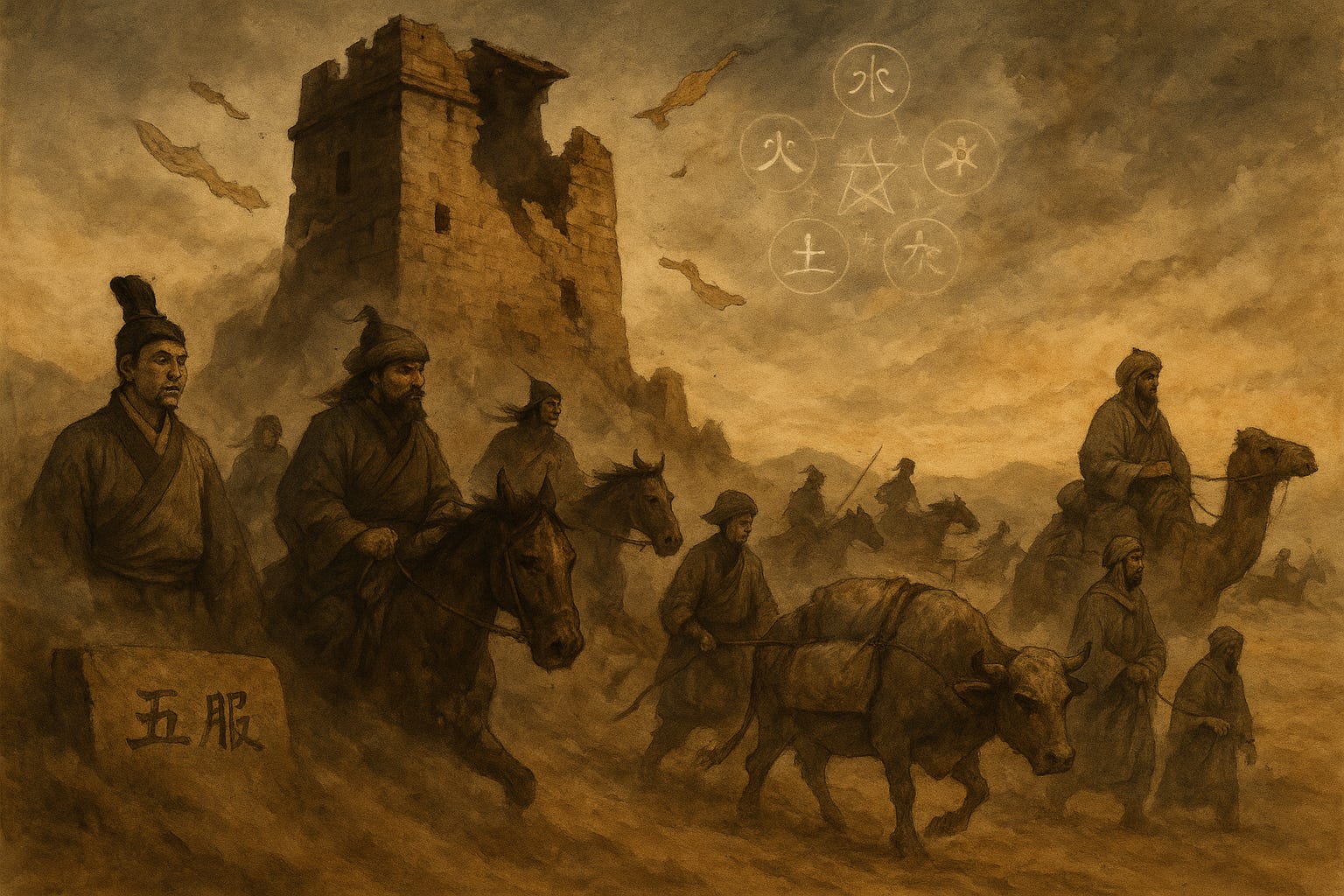
Borders, identity and walls are all the rage these days. So, what better wall to contemplate than the Great Wall of the Central Kingdom? It is a potent symbol of Chinese civilisation. It is also a misleading one. The Great Wall suggests a stark line dividing civilisation, and the Hànzú (漢族), Han Chinese, from the barbaric, foreign chaos beyond. Tanks of ink have been spilt making precisely that case — and by writers with sharper quills. The Romance of the Three Kingdoms novel is one such. Yet, Chinese history is one of synthesis, not fissure. Today, the People’s Republic extends beyond the Great Wall and acknowledges far more than the Hànzú as Chinese.
Is that phenomenon new, alien or strange, or has that been the case from the start? I believe the latter. More than that, I think that fact demonstrates the universal truism that scale begets heterogeneity, and that individuals barred from power/resources within will seek aid from without to achieve their desires.
In the specific case of China — the geographic entity — it seems to me that the decisions made by the country’s past historical actors created a pattern that recurred throughout its history and which still resonates to date.
But our path to understanding starts from the beginning, not with Liu Bang and his drunken reverie at Pèi Xiàn (沛縣) but with Zou Yan (鄒衍) (305-240? B.C.) and geography.
Zōu Yǎn was born in the Warring States era. He was a leading figure of the School of Naturalists, Yīnyáng Jiā (陰陽家). He systematised two cosmological theories dealing with Yīn and Yáng and Five Phases (Wǔ Xíng) that influenced the emerging conception of Statecraft in China. He also believed that the world was divided into Grand Continents, each further subdivided into nine regions that left China as one of many — the Red continent, Chìxiàn Shénzhōu (赤縣神州) — within a much larger global structure.
Zōu Yǎn’s influence abstracted the classical perception of China as (天下) Tiānxià — all under heaven — to the political realm. Tiānxià became all the lands over which the emperor’s supremacy was accepted unchallenged. There could no more be two rulers of equivalent status in Tiānxià than there could be two suns above. Thus, at least in the period I’ve just spent a great deal of time boning up on, claiming the title of emperor was an invitation to rivals to submit or be eliminated.
To the Han-era eggheads in charge of ordering the world based on sustained engagement with a set of texts, this all made perfect sense. The emperor was the locus of authority, and the world ought to be ordered with him at its centre.
According to the Wǔfú (五服) theory, since the time of the Xia, AKA time immemorial, the world was ordered into five concentric and hierarchical zones. They were:
Diànfú (甸服): The royal domain under the direct rule of the supreme lord.
Hóufú (侯服): The domain of the kingdoms enfeoffed by the supreme lord.
Bīnfú (賓服): The domain of lands pacified via direct imperial conquest.
Yàofú (要服): The domain of subordinated non-Hànzú dependencies like the Nán Mán (南蠻) and Dōng Yí (東夷). Note that this was before Hàn Wǔdì (漢武帝) (141—87 B.C.), ehm, upgraded them to Bīnfú (賓服).
Huāngfú (荒服): The wild unknown populated by sovereign, typically aggressive, non-Hànzú ethnicities and polities.
Paradoxically, the rigid concept of Wǔfú proved to be a dynamic metabolism designed to digest external actors by providing a clear and defined hierarchy to approach, emulate, and, in the specific case of many northern Huāngfú polities, ascend! That is because rather than being strictly exclusionary, it structured the relationship between ruler and subject in terms of tribute and access.
The system ran on tribute, and the five zones provided them in descending order from Diànfú to Huāngfú. The Diànfú paid tribute daily and the Huāngfú just once. In simpler terms, the more you gave and the less you received, the closer you were to accessing imperial power. Service was your passport through the Great Wall and the passes separating domains from each other.
These abstract hierarchies had practical effects, not only for the Han Dynasty (漢朝) and other Hànzú empires in China's history but also for the non-Hànzú who would one day proclaim their supremacy in Tiānxià.
In 196 BC, Liu Bang returned, in triumph, to his home county. At that moment, he was the world spirit on horseback. The Hàn Gāozǔ (漢高祖) wasn’t just the founding ancestor of a dynasty that cemented the Qin’s achievement, he was also the creator of a regime that endured in China for two thousand years and inspired regional emulation. The burdens of power were immense, and his thoughts drifted to the future. Lost in his cups, he sang an ode to the Great Wind.
大風歌 (Dà Fēng Gē)
大風起兮雲飛揚,
威加海內兮歸故鄉,
安得猛士兮守四方!
The great wind roars, the clouds now fly,
I rule all lands — homeward draw I.
But where are heroes, bold and fast,
To hold the line from first to last?
The great Han court did not lack heroes in the years to come, but where to hold the line, who could share in their bounty, and what price to charge for access? Those were the questions his heirs would have to answer. What follows is their story and some analysis.
Former Han: Expansion as Assimilation
In the early decades of the Former Han, its dealings with the formidable Xiongnu steppe confederacy were an exercise in coexistence, not conquest. The kernel of this policy was the Héqīn (和親) or harmonious kinship system. It was an intricate blend of diplomatic appeasement born from the (漢高祖) Hàn Gāozǔ’s chastening military defeat at Píngchéng in 200 B.C.
The subsequent treaty established the Han and Xiongnu as brotherly States of equal standing and was sealed by sending a Han princess (of unproven provenance) to marry the (匈奴單于) Xiongnu Chányú, or supreme ruler. This was intermarriage as power-sharing. With a new princess often dispatched upon the accession of a new ruler on either side, they served as crucial political brokers, cultural ambassadors and living assurances that the delicate alliance held. It is worth noting that the Héqīn policy simply adapted accepted diplomatic practice among the Hànzú during their pre-imperial age to the international arena.
A constant flow of resources from the sedentary empire to the nomadic one underpinned this diplomacy. The Han court regularly sent fixed quantities of silk, liquor, rice and other foodstuffs to its northern neighbours. They also established supervised trading points. This was not bribery so much as a form of ecological competition masked in the language of civilisation.
The Han Empire offered the grain and luxury goods its settled economy produced in abundance to dissuade the Xiongnu from taking them by force. In the process, as the Xiongnu developed a taste for those products, some sought to understand their methods of production. On the one hand, they abandoned their nomadic lifestyle and the associated violence; on the other, they sought Hànzú tutors. Thus, a path to beat swords into ploughshares emerged. Of course, this trading relationship spawned a new set of interests that the Han court could not necessarily control. For example, there were many, perhaps lost to history, who no doubt made immense fortunes and valuable contacts by smuggling contraband into Huāngfú.
Regular shipments of Chinese silk and rice, not the Great Wall, held the marauding Xiongnu cavalry in check. Yet this was a fragile equilibrium. The Xiongnu leader Mòdú was a ruler of extraordinary ability who used the threat of his horsemen to renegotiate terms from a position of strength, compelling the Han court to accept his self-aggrandising titles and demands and, essentially, subsidise his imperial ambitions in Central Asia.
The purely defensive posture of the Han court began to shift with the opening of the Western Regions. The missions of the envoy Zhāng Qiān (張騫) were a masterstroke of strategic intelligence gathering. The Han court, hoping to be a wise monkey perched on a tree while tigers fought in the valley, dispatched Zhāng Qiān to seek an alliance with the Yuezhi people against the Xiongnu. No dice — the Yuezhi quite liked a life of peace. However, the envoy’s travels yielded knowledge — a far more valuable resource. He pioneered the first direct contacts between the Han court and the oasis states of Central Asia, such as Wusun, Ferghana and Bactria.
Diplomacy and trade laid the foundations of Empire. The fabled horses of Ferghana became an object of imperial desire, a military asset worth launching a hugely expensive four-year campaign to acquire. The conquest of Ferghana demonstrated the Han court’s logistical reach and awed the States of the Western Regions into submission. From then on, the Han Empire projected its power along these new trade routes, slowly drawing the city-states of the Tarim Basin into its orbit through a combination of military threat, diplomatic overture and the strategic colonisation of fertile oases via the túntián (屯田) system.
The túntián system was a court-sponsored military-agricultural colony, where soldiers or civilians farmed frontier lands to produce their own food, thereby providing self-sufficient garrisons that enabled the Han Empire to project and sustain its power and presence in the distant Western Regions. To get a sense of the logistical difficulties involved in projecting military might to the west, consider the following.
On average, for a three-hundred-day journey, one soldier consumed 360 litres of dried rice, which had to be carried by ox. The food for each ox meant an additional 400 litres of weight. While campaigning in the desert, it was expected that the ox would die within one hundred days; yet the remaining 240 litres of dried rice would still be far too heavy for the soldier to carry. Compounding the issue was the importance of carrying enough fuel to fight the cold of the northwestern winters.
Given the above, it’s not an exaggeration to state that Han imperium would have been impossible to sustain without those networks of self-sufficient military bases on its northwestern frontiers.
The Han court’s imperium in the west culminated in the appointment of a Protector-General in 60 B.C. to regulate affairs in the region. The Han had established protectorates, if you will. This was Yàofú.
A similar, if distinct, process unfolded in the south. In the lands of Nányuè (南越), incorporating parts of modern southern China and northern Vietnam. The Han emperors initially confirmed the authority of a local king, Zhao Tuo (趙佗), treating him as a nominal vassal. This was a pragmatic recognition of local power. However, when Zhao Tuo’s successors claimed imperium in their own right, the Han empire responded with overwhelming force, invading in 112 B.C. and replacing the native kingdom with no fewer than nine centrally administered commanderies. This was Bīnfú.
Even in the south, direct rule was tempered by reality. The local inhabitants, who spoke different languages, were by no means assimilated overnight. Governance was a careful dance involving the management of aboriginal potentates, imperial officials developing local power structures and Han colonists — especially as more fled southwards from the flooding Yellow River in AD 11. However, the settlement of Hànzú colonists and the gradual introduction of agriculture and Confucian mores spurred a slow process of cultural transformation.
Wang Mang’s Folly: When Elasticity Snaps
The delicate, decentralised and often pragmatic system of managing the frontiers had limits, and it was stretched to breaking point during the reign of the idealistic reformer, Wang Mang (A.D. 9-23). The (新朝) Xin Dynasty’s first emperor mistook the rituals of tribute for the reality of power. Where the Former Han had learned to accommodate the pride of its neighbours, Wang Mang was an ideologue, driven by a rigid insistence on the absolute supremacy of the Son of Heaven. He provoked the Xiongnu by attempting to treat their leader not as the ruler of a brotherly State, but as a lowly subject. This rejection of negotiated authority, the bedrock of the Héqīn system, was imperial hubris.
When the Wuhuan people, who were legally under Han protection, killed Xiongnu tax collectors in A.D. 8, Wang Mang’s government failed to protect them from brutal retaliation. His subsequent use of Wuhuan troops, whose families were held hostage and then executed when the soldiers deserted, drove them into open revolt and alliance with the Xiongnu. Wang Mang’s rigidity transformed manageable frontier friction into a full-blown crisis. The blowback from his poor management of the five zones, compounded by the generational disaster of the Yellow River switching course, ushered his new era to the dustbin of history.
Later Han: The Empire’s Inner Fractures
When the Han Dynasty was restored in the year 25, it faced a radically altered strategic landscape. Its genius lay in turning its enemies’ divisions to its own advantage. Around A.D. 48, the Xiongnu split into two warring factions, the Northern and Southern Xiongnu. The Later Han court immediately seized the opportunity, bringing the Southern Xiongnu, led by the Chányú Pi, into the tributary system in A.D. 50. The southern tribes were handsomely rewarded with cash, silk and provisions in exchange for their submission. More importantly, they undertook the obligation to guard the Han frontiers against their northern brethren. This edged fairly — dangerously, if you were mired in central zone clique politics — close to being Hóufú.
That created a new and dangerous dynamic. The empire now outsourced its frontier defence to ethnic garrisons. Southern Xiongnu cavalry became the policemen of imperial border towns. While this was effective, it blurred the lines between subject and master, ally and mercenary. Meanwhile, the tributary system was tightened, with a new Han official, the Commander of the Gentlemen-of-the-Household Serving as Instructors to the Xiongnu, created to monitor the southern Chányú’s every move. The Southern Xiongnu were resettled within eight frontier commanderies, effectively becoming inner subjects of the empire. The Han court had bought security. They had also introduced new political actors with a powerful, semi-autonomous military force into its regime politics.
On the Silk Road, the legendary general Bān Chāo (班超) embarked on a decades-long career in the Western Regions that a masterclass in diplomacy backed by minimal force. He understood that local allies were more valuable than large Hànzú armies. He skillfully played the rivalries of the Tarim Basin city-states against each other, using the ambitions of one to subdue the next. The title Protector-General was a grand one, but the reality of power was that of a mediator, not a master. His authority depended on the consent and cooperation of the local rulers he sought to control.
The proliferation of services offered by non-Hànzú auxiliaries was fomenting a political crisis that came to a head with the Qiāng (羌) of the western and southwestern frontiers. The Han court settled the Qiang inside the empire to sever their ties with the Xiongnu and to alleviate population pressure. The Qiang perceived the establishment of tuntian — the court-sponsored military colonies discussed above — on their pasturelands as a malevolent sign. This miscommunication didn’t end there, Han officials — despatched from the imperial heartlands to avoid conflicts of interest — were aghast at the barbarising effect the Qiang had on their Hànzú neighbours. One harried official even petitioned the court to issue every household in the province with a copy of the Book of Filial Piety. That was the extent to which he perceived that even the Hànzú of Liángzhōu (涼州) had fallen from the basic precepts of their civilisation.
Officials from the frontiers — occasionally of non-Hànzú parentage — grumbled at the ease with which officials from the central plains advocated that the empire retrench and abandon their homelands. They also faced no small measure of prejudice. You son of a Qiāng barbarian!, the widow of famed general Huángfǔ Guī (皇甫規) once snapped at the noted filial son-haver, Dǒng Zhuó (董卓).
Those accumulating grievances erupted in a large-scale rebellion in Liangzhou province in A.D. 110. Its temporary suppression cost the Han court an astronomical twenty-four billion coins and pushed the court to retrench its borders. However, the prospect of forced evacuation worsened the revolt and drove many Hànzú colonists into the arms of their Qiang neighbours. Both groups acted in concert on the basis of their shared regional identity.
Imperial Metabolism: The Frontier Feeds on the Empire
This imperial assimilation process placed an unsustainable strain on the imperial core. The resource drain was immense. For example, the silk, gold and cash lavished upon the Southern Xiongnu Chányú Hūhánxié for his submission were staggering, and his second visit was rewarded with even more. Annual payments to Xianbei chieftains later in the dynasty reached a cash value almost three times that given to the Southern Xiongnu — a clear indicator of the escalating cost of buying peace. The grain required to provision the garrisons and colonies on the frontiers often came at the expense of the interior provinces.
By the end of the Later Han, as private militias proliferated, some of the empire’s most effective fighting forces were not Hànzú soldiers, but the non-Hànzú auxiliaries and the frontiersmen who had been fighting the court’s wars for generations. Warlords like the infamous Dong Zhuo rose to power from the imperial periphery, specifically, the turbulent Liangzhou frontier, where he had commanded troops of multiple ethnicities.
There was a gaping maw between the western frontier society of Liángzhōu on the one hand and the eastern part of the empire (popularly known as Guāndōng (關東), that is, the lands east of the passes protecting Guanzhong (關中), the central domain, on the other.
Toward the end of the second century, those two groups, led by Dǒng Zhuó and Yuán Shào, respectively, engaged in a life-and-death struggle at the court with the eunuchs defending imperial supremacy (yes, ignore centuries of the Guanzhong clique slander or just watch Ming Dynasty 1566 xd). When Dǒng Zhuó succeeded in establishing undisputed control over the court in 190, his very first step was to move the capital westward, closer to his power base in Liángzhōu. The mutual distrust and hostility between the two groups burst wide open in 192 after the assassination of Dǒng Zhuó and set the empire on the irrevocable path to civil war.
The frontier forces created to defend the empire had developed their own loyalties and identity, distinct from the court eunuchs and scholar-officials of the capital. When they marched on Luoyang, the empire struck back, metaphorically. The assimilationist metabolism had reversed; the periphery was now consuming the centre, and the meaning of Chinese would not be the same afterwards.
The Legacy: Unstable DNA
The Han Empire pursued many policies in international politics. They ranged from the Héqīn alliances that treated the Xiongnu as equals to the shuguo(屬國), or dependent States. Shuguo status was an imperial arrangement that allowed non-Hànzú peoples to live under their own customs and outside imperial borders while serving as agents of the Han court in exchange for tribute and military service.
The fuzzy middle between those extremes was a pragmatic response to the limits of direct control that accelerated a process of peripheral ethnic cum national fusion between the frontier Hànzú and their neighbours. The statesmen of the Later Han were ill-equipped to deal with that growing complexity. So, they were forced off the political stage by surging waves they could not surf.
The collapse of the Han did not end this process of ethnic fusion; rather, it accelerated it. The centuries that followed saw the rise of hybrid States, most notably the Northern Wei, founded by the Xianbei. They had learnt statecraft on the Han’s northern frontier and were in the process of transitioning to the Hóufú domain before the Han Empire collapsed.
Going forward, in practical terms, the sedentary farmers, despite their monopoly on the pen, did not define Chinese history. Their present and future was irrevocably tied to their northern, western and southeastern non-Hànzú neighbours and the children of shared heritage many frontier Chinese would have.
The genius of Han statesmen was their ability to weave steppe horsemen, northern wheat growers, southern rice farmers and oasis traders into a single, expansive imperial tapestry. Their tragedy was the inability of a narrow metropolitan elite to accommodate the powerful, hybrid identities they had themselves created, and to recognise that those who guarded the frontiers had every right to claim the palace too.
I found this a story worth contemplating. For one, the institutional arrangements the Han statesmen fashioned have echoes in other imperial regimes. At this point, I’d wager that all empires were some unwieldy combination of colony, protectorate and dependency.
Second, it’s also helped me make progress on a concept I’ve been trying to untangle — namely that societies are a coalition of interests and politics the clash between those interests. Societal crises hinge on the ability of extant political actors to accommodate or liquidate emergent interests.
Anyways, I’ll likely wrap this up with two more straightforward stories — one a tale of harem politics and swashbuckling chivalry and the other the Ancients Guide to Counter Programming AKA Burying the Scholars.
Thanks for your attention to this matter o: